Introduction
Choosing the right harness for a large or working dog is about more than finding something that looks rugged. A powerful dog can put substantial force through a harness, while a service dog may need reliable handling, clear identification, and comfortable movement throughout the day. That is why tactical dog harnesses with handle designs have become popular among owners of large breeds, working dogs, hiking dogs, and trained service animals.
A well-designed tactical harness can provide a secure point for close control, distribute leash pressure across the chest, and offer practical features such as MOLLE panels and identification patches. However, not every harness marketed as “tactical” is built for demanding use. Construction, sizing, handle placement, hardware, padding, and freedom of movement all deserve attention.
This guide explains what to look for when choosing tactical dog harnesses with handle designs for large breeds and service dogs, how to achieve a proper fit, and which features matter most for everyday handling.
Why Choose Tactical Dog Harnesses With Handle?
A traditional harness can work perfectly well for a calm dog that walks politely. Large breeds and working dogs, however, can benefit from additional control features.
A top handle gives the handler a convenient grip when a dog needs to remain close. It can be useful when moving through crowded areas, entering a vehicle, navigating stairs, or briefly redirecting a dog during training.
The handle should not be confused with a lifting device. Unless the manufacturer specifically designs and rates it for lifting, it is safer to treat it primarily as a close-control handle. Some current tactical harnesses advertise reinforced handles specifically for control and assistance, but published weight ratings vary considerably between products.

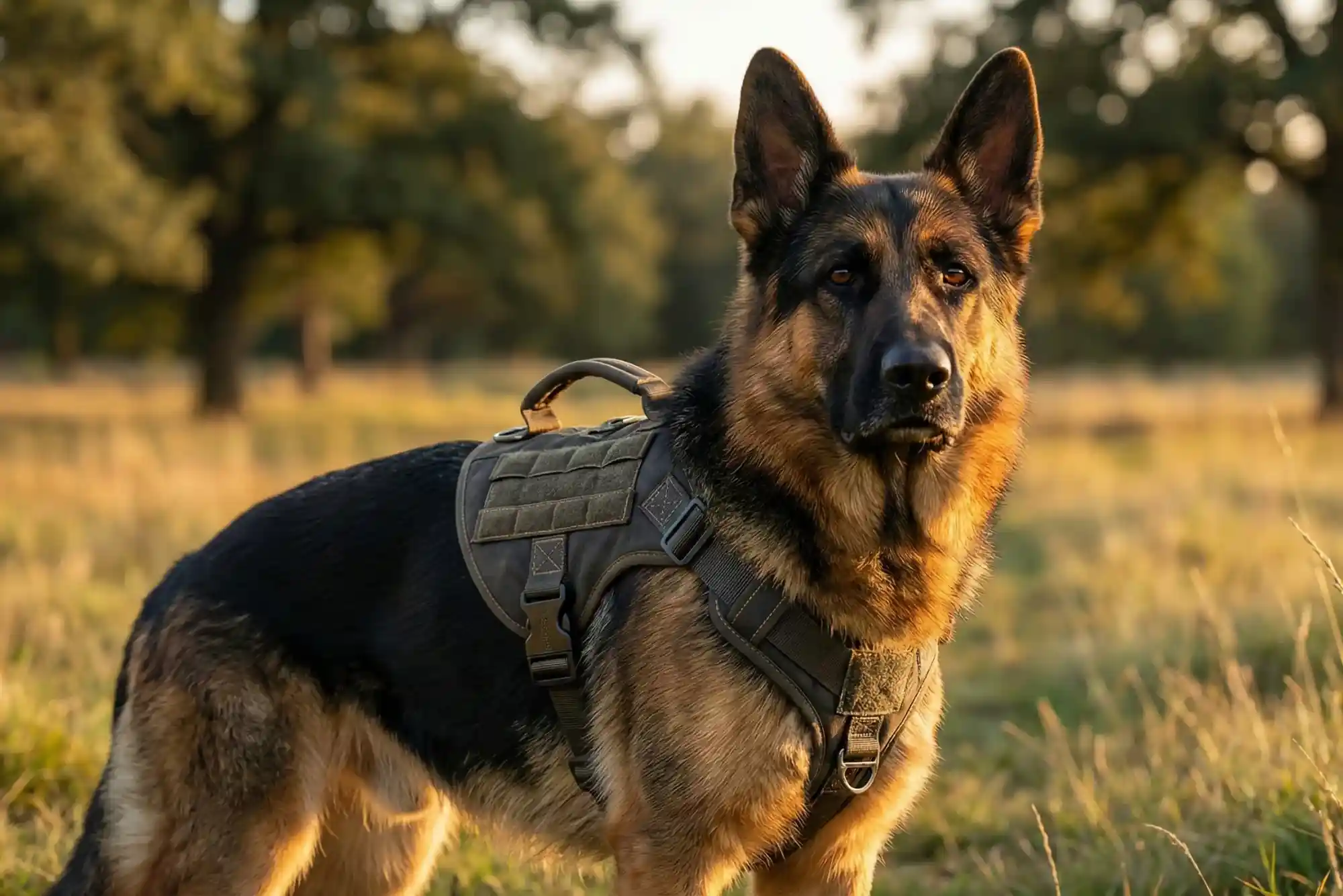
Tactical designs may also include stronger webbing, reinforced stitching, multiple leash attachment points, MOLLE-compatible panels, and hook-and-loop areas for identification patches. These features can be useful for working and active dogs when they are actually needed rather than included simply for appearance.
What Makes a Tactical Dog Harness Different?
The word “tactical” is widely used in the pet-product market. A camouflage pattern alone does not make a harness suitable for demanding work.
Heavy-Duty Materials
Many tactical-style harnesses use heavy nylon fabrics designed to withstand abrasion and repeated outdoor use. Some current products advertise 1000D or 1050D nylon construction, although fabric weight alone does not tell you how strong the complete harness is. Stitching, webbing, buckles, and attachment points matter just as much.
For a large dog, inspect the areas where the leash rings and handle connect to the harness. These are high-stress areas and should have visible reinforcement.
A Reinforced Handle
The handle is one of the main reasons owners search specifically for tactical dog harnesses with handle designs.
A useful handle should be securely integrated into the harness rather than appearing to be a thin fabric loop sewn onto the top. A rigid or semi-rigid handle can make close control easier, particularly when a strong dog suddenly changes direction.
Handle placement matters too. A handle positioned too close to the neck can cause the front of the harness to shift upward when pulled. A properly designed harness should maintain stable contact with the chest and shoulders during normal handling.
Multiple Adjustment Points
Large breeds come in many different body shapes. A German Shepherd, Rottweiler, Labrador, Great Dane, and Mastiff can have very different chest and neck proportions even when their body weights are similar.
Multiple adjustment points allow the harness to sit securely without becoming excessively tight. Current tactical harness designs commonly use four or more adjustment areas to improve stability and reduce shifting.
Important Features for Large Breeds
Large dogs need a harness that stays stable under movement without restricting natural motion.
Wide Chest Coverage
A broad chest panel can help distribute pressure over a larger area. This is particularly useful when a strong dog pulls forward.
The harness should sit comfortably around the chest without pressing into the throat. The shoulder area should also remain clear enough to allow normal movement.
Strong Leash Attachment Points
A harness may have front and rear leash attachment points for different handling situations. A rear attachment is commonly useful for ordinary walks, while a front attachment can provide additional steering during training.
The important consideration is whether the attachment point is structurally integrated into the harness. A strong metal ring does not automatically make the entire attachment system strong.
Secure Buckles
Quick-release buckles make putting the harness on and removing it easier. For large working breeds, examine the buckle construction and how securely it locks.
Some heavy-duty products use metal hardware, while others use reinforced polymer buckles. Instead of assuming one material is automatically suitable, look at the manufacturer’s specifications and the overall construction.
How to Choose Tactical Dog Harnesses With Handle for Service Dogs
Service dogs have different requirements from ordinary companion dogs. The harness should support the dog’s working routine without interfering with movement or creating unnecessary weight.
A service dog harness may need a comfortable handle, identification patches, a stable fit, and enough adjustability for extended wear. Some harnesses provide hook-and-loop panels for labels such as “SERVICE DOG” or “DO NOT PET.”
However, a harness itself does not determine whether a dog has service-animal status or public-access rights. In the United States, the Department of Justice states that service animals are not required to wear a specific vest, harness, or identification.
For that reason, choose equipment according to the dog’s actual working needs rather than assuming a tactical appearance provides legal recognition.
MOLLE Webbing: Useful or Unnecessary?
MOLLE webbing is a common feature of tactical harnesses. It provides attachment points for compatible pouches and accessories.
For a working dog, this can be useful for carrying small identification or emergency items. Outdoor owners may also use compatible attachments for lights or other lightweight accessories.
However, more attachment space is not automatically better. Extra pouches can increase weight, bulk, and heat. If your dog does not need additional equipment, a simpler harness may be more comfortable.
This is particularly important for service dogs that may wear their harness for long periods. Function should come before the tactical appearance.
How Should a Tactical Harness Fit a Large Dog?
Correct sizing is arguably more important than choosing a particular material or brand.
Measure your dog’s chest circumference around the deepest part of the rib cage, generally just behind the front legs. Compare that measurement with the manufacturer’s actual size chart rather than choosing a size based only on body weight.
A properly fitted harness should remain stable when the dog walks, turns, sits, and changes direction. It should not rotate significantly from side to side.
The neck opening also deserves attention. The harness should sit below the throat without rubbing the neck or restricting movement. At the same time, it should not be so loose that the dog can reverse out of it.
After adjustment, walk your dog for several minutes and inspect the contact points. Look for rubbing around the armpits, chest, neck, and behind the front legs.
How Does a Handle Improve Control?
The biggest advantage of tactical dog harnesses with handle designs is having an immediate point of contact close to the dog’s body.
Imagine walking a large dog through a busy parking area. If the dog suddenly becomes distracted, reaching for a top handle can provide closer physical control than trying to shorten a long leash.
The same principle can be helpful when entering elevators, crossing difficult terrain, loading into a vehicle, or moving through crowded training environments.
For a trained service dog, the handle may also be part of the handler’s equipment setup. However, whether a particular handle is appropriate for mobility assistance depends on the dog’s training, health, and the manufacturer’s intended use.
Comfort Matters as Much as Strength
A harness can be extremely durable and still be a poor choice if the dog cannot comfortably wear it.
Look for padding around areas that experience regular contact. Breathable mesh can also help reduce heat and moisture during longer walks. Some current tactical harnesses combine padded pressure areas with breathable lining for extended use.
Watch your dog during the first few sessions. Excessive scratching, changes in gait, reluctance to walk, or repeated attempts to remove the harness can indicate discomfort or poor fit.
The harness should support movement rather than make the dog feel restricted.
Common Mistakes When Buying a Tactical Dog Harness
One common mistake is choosing a harness based entirely on appearance. Camouflage fabric, MOLLE webbing, and a large handle may look impressive, but those features do not guarantee good construction.
Another mistake is ignoring the manufacturer’s size chart. Two “XL” harnesses can have completely different chest measurements.
Some owners also assume that a heavy-duty handle means the dog can safely be lifted by it. Unless the manufacturer explicitly states that the harness and handle are designed for lifting, use the handle for controlled handling rather than suspending the dog’s body weight.
Finally, avoid adding excessive accessories. A tactical harness should remain practical and comfortable. More gear can mean more weight and heat without providing a meaningful benefit.
Tactical Harness vs. Standard Harness
A standard walking harness may be sufficient for a dog that has moderate leash behavior and does not need additional equipment.
A tactical design becomes more relevant when you need features such as a reinforced control handle, multiple attachment points, MOLLE-compatible webbing, identification panels, or heavier-duty construction.
That does not mean every large dog needs tactical equipment. The correct choice depends on your dog’s size, temperament, activity level, training, and intended use.
For a family pet that takes relaxed neighborhood walks, a lightweight harness may be more practical. For an active working dog regularly exposed to demanding environments, the additional construction may make more sense.
How to Maintain a Tactical Dog Harness
Even heavy-duty equipment needs regular inspection.
Check the stitching around the handle, leash rings, and adjustment points. Look for frayed webbing, damaged buckles, loose threads, or distorted metal hardware.
Clean the harness according to the manufacturer’s instructions. Dirt and moisture can accumulate underneath padding and around buckles, especially after hiking or outdoor work.
Allow the harness to dry completely before storing it. Regular inspection is especially important for large dogs because their strength can place considerable stress on attachment points.
Are Tactical Dog Harnesses With Handle Worth It?
For the right dog and the right situation, tactical dog harnesses with handle can provide useful control and durability.
Their value comes from practical construction rather than the tactical label. A good model should fit the dog’s chest correctly, remain stable during movement, provide a secure handle, and use suitable hardware and reinforcement.
For service dogs, comfortable long-term wear and appropriate identification features may be more important than maximum ruggedness. For hiking and working dogs, durability and attachment options may receive greater attention.
The best harness is therefore the one that matches the dog’s actual needs rather than simply having the longest feature list.
Choosing among tactical dog harnesses with handle options requires more than comparing colors and tactical styling. Large breeds need stable construction, appropriate chest coverage, reliable adjustment, and a handle that supports close control. Service dogs need comfortable equipment that fits their working routine without unnecessary bulk.
Before buying, measure your dog’s chest carefully, inspect the handle and attachment points, check the manufacturer’s specifications, and consider how the harness will actually be used. A well-fitted harness can make daily handling more practical while giving you a dependable control point when you need it.
FAQs
Are tactical dog harnesses good for large dogs?
Yes, they can be useful for large dogs when correctly sized and appropriately constructed. Large breeds can benefit from reinforced attachment points, a stable chest panel, and a strong control handle. Always check the manufacturer’s size and weight guidance rather than relying on the “large” label alone.
What is the best harness for a large dog that pulls?
There is no single harness that suits every large dog. Look for a design that fits the chest securely and provides an appropriate leash attachment point for your training method. A front attachment can provide additional steering for some dogs, while professional guidance may be useful for persistent pulling.
Can you lift a dog by a tactical harness handle?
Not necessarily. A handle should only be used for lifting if the manufacturer specifically designs and rates the harness for that purpose. Otherwise, treat it as a close-control handle rather than a lifting point.
What harness do service dogs wear?
Service dogs do not have to wear one specific type of harness. Handlers may choose equipment based on comfort, identification, control, or task requirements. In the United States, federal law does not require service animals to wear a specific vest or harness.
How tight should a tactical dog harness be?
It should be secure without restricting breathing or movement. The harness should not slide excessively or allow the dog to back out, but it also should not dig into the neck, chest, or armpits. Always follow the manufacturer’s fitting instructions.
Do tactical dog harnesses stop pulling?
A harness does not automatically stop pulling. Some designs with front attachment points can provide additional steering and may make pulling easier to manage during training. Long-term improvement generally depends on consistent loose-leash training rather than equipment alone.
Are tactical harnesses comfortable for dogs?
They can be comfortable when properly designed and correctly fitted. Padding, breathable materials, adequate shoulder clearance, and correct adjustment all matter. A heavier tactical harness may be unnecessary for dogs that only need basic walking equipment.
What should I look for in a tactical dog harness?
Focus on correct chest sizing, secure adjustment, reinforced attachment points, a well-integrated handle, comfortable padding, suitable hardware, and appropriate weight. MOLLE panels and patch areas are useful when you actually need them, but they should not replace basic fit and comfort.